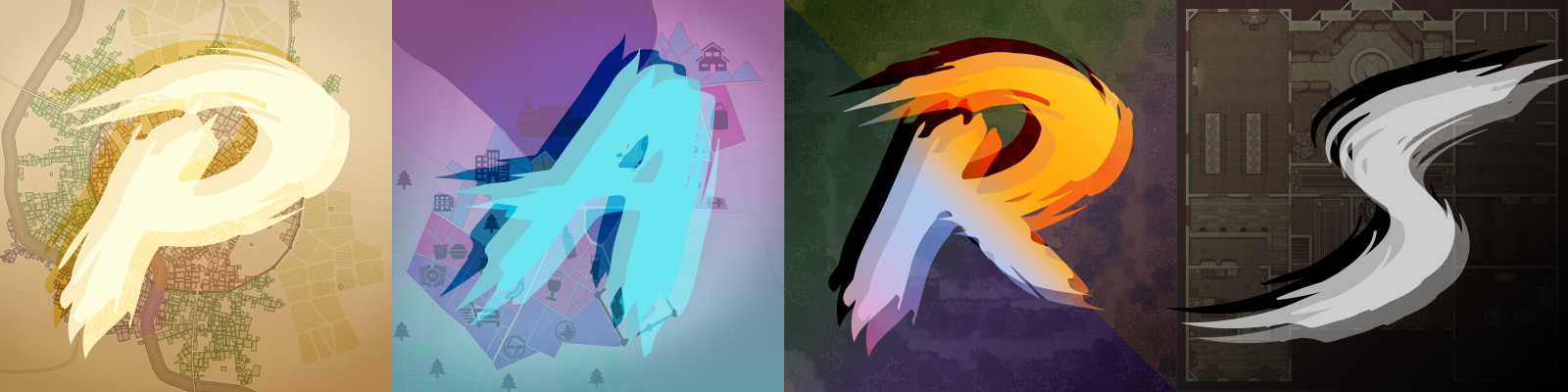
So. What the fuck is PARS?
First of all, what is PARS NOT?
-A commercial product that is available for sale
-A publicly joinable or contribuable project
-An intentional parody of any one specific thing or commentary on any specific time
-An acronym of any meaning or purpose
What then, IS PARS?
-A friendgroup based story telling medium encompassing many different forms and styles
-An expansive world of characters and lore ranging (at time of writing) from the 1970's/1980's through the early 2050's
-In the words of my partner and myself, "a collection of scenarios exploring a post-collapse fiction. A fictional account of what comes after," and "A world connected by common threads exploring uncommon but familiar circumstances."
Essentially, PARS is a multi-year long project built by myself and many friends (and no longer friends) from across the US. Our origins stem from Apocalypse World 2e, but to be honest, I have already written about the history of how PARS was started on my Obsidian site that serves as a wiki for most of PARS content that is shared. The Obsidian PARS Vault is a collaborative effort between myself and primarily my partner to catalogue and centralize PARS and its contents for strangers and friends alike to read and browse. It is designed to host meta commentary, in universe documents, character sheets and references, and Extended Fiction. Extended Fiction in particular is a main focus for us in an attempt to move away from hosting our stories and projects purely in Google Drive. You can find a link to that site directly here, as well as on my index :P
-A commercial product that is available for sale
-A publicly joinable or contribuable project
-An intentional parody of any one specific thing or commentary on any specific time
-An acronym of any meaning or purpose
What then, IS PARS?
-A friendgroup based story telling medium encompassing many different forms and styles
-An expansive world of characters and lore ranging (at time of writing) from the 1970's/1980's through the early 2050's
-In the words of my partner and myself, "a collection of scenarios exploring a post-collapse fiction. A fictional account of what comes after," and "A world connected by common threads exploring uncommon but familiar circumstances."
Essentially, PARS is a multi-year long project built by myself and many friends (and no longer friends) from across the US. Our origins stem from Apocalypse World 2e, but to be honest, I have already written about the history of how PARS was started on my Obsidian site that serves as a wiki for most of PARS content that is shared. The Obsidian PARS Vault is a collaborative effort between myself and primarily my partner to catalogue and centralize PARS and its contents for strangers and friends alike to read and browse. It is designed to host meta commentary, in universe documents, character sheets and references, and Extended Fiction. Extended Fiction in particular is a main focus for us in an attempt to move away from hosting our stories and projects purely in Google Drive. You can find a link to that site directly here, as well as on my index :P
PARS is Queer art. The majority of our players as well as our characters are queer or LGBT+ in some form. Apocalyptic fiction is always political despite what some less informed about
the genre may think or say. Science-fiction and disaster art are reflections of the consequences of a society that fails to uphold its necessary functions to prevent an easily avoidable
outcome such as famine, disease, weather disasters, nuclear bombs, (etc.) PARS in particular is the tale of a post-collapse America where roughly a 3rd of the country is wiped out by what
is aptly named "Collapse Sickness". Along with disease is a societal crumbling and near total loss of governmental oversight.
PARS is a reflection of ourselves and what we find to be fascinating, enticing, repulsive, and everything between. Who would I be if I hadn't ever had a chance to get to college? Some
characters in their proximity to their creators remind me of Jan Dolski from The Alters; versions of ourselves where many things are the same but something shifted. I see parts of myself
in every character I have made, PC or NPC. Many of our campaigns aim to provide us with new perspectives within new playboxes and enviroments. One such campaign, named Island Castaway
placed players in the shoes of celebrities stranded on an island on D-Day of The Collapse. Doomed from conception every player competed after providing us (my partner and myself) with a
charity of choice. At the end, the last standing contestant earned a donation for that charity. Another campaign, set in the 1980's, gave us a chance to analyze one of our major villains
from a chronologically later campaign named "ABC" through the lens of the people who knew her when she was created. PARSopoly, or "The Business Campaign" is set the latest in our current
timeline and explores how people have come to develop the world that has been left behind.
PARS is an exploration of us. In The Karma Project, I gave each player a task:
"I need you to write a character up to the age of about 20-30. After that I will have an event that I design for your character to have gone through and you'll need to put down how their life trajectory changes or how they change. What things in their life do they go about differently and what kinds of lies do they tell to cover up this ever happening. Do they take the issue with any grace or do they become a different person, etc.
Detail general career, family life, hobbies, abilities, habits, etc.
General wealth and status would help too
The campaign will be set 2050
So post collapse but all players would be born pre collapse
The more detail the better."
This was the prompt, and each of the three members of the group responded with characters that fit perfectly. After providing them with their events, I added one more request for them aside from how their characters' lives changed after the event:
"Also, tell me how they die. They must be dead by 2050."
Immediately, the entire context of the characters shifted, and led to an incredibly fun and challenging campaign that was created to force players to examine what they view to be the point of trying to make things better following their own deaths. Each player had a unique and interesting perspective that I have used as the basis for not only future campaigns, but art pieces, Extended Fiction pieces, new character arcs, and my own views and morals.
"I need you to write a character up to the age of about 20-30. After that I will have an event that I design for your character to have gone through and you'll need to put down how their life trajectory changes or how they change. What things in their life do they go about differently and what kinds of lies do they tell to cover up this ever happening. Do they take the issue with any grace or do they become a different person, etc.
Detail general career, family life, hobbies, abilities, habits, etc.
General wealth and status would help too
The campaign will be set 2050
So post collapse but all players would be born pre collapse
The more detail the better."
This was the prompt, and each of the three members of the group responded with characters that fit perfectly. After providing them with their events, I added one more request for them aside from how their characters' lives changed after the event:
"Also, tell me how they die. They must be dead by 2050."
Immediately, the entire context of the characters shifted, and led to an incredibly fun and challenging campaign that was created to force players to examine what they view to be the point of trying to make things better following their own deaths. Each player had a unique and interesting perspective that I have used as the basis for not only future campaigns, but art pieces, Extended Fiction pieces, new character arcs, and my own views and morals.
PARS is experimental art. In every campaign we make a new advancement, change, upgrade, or discovery that changes how we engage with storytelling. In the beginning we had simple backgrounds
that were evolved to full color maps in ABC as well as the establishment of the "PARS standard" portrait style of using random people's faces off the internet and tracing over them.
Following ABC, in Coumac, was the establishment of the "posterized" or three tone style of portraits and maps; inspired heavily by the neon trends of the 70's and 80's thsi campaign began the usage of posterized and color picked portraits for expedience, but also tone setting.
In Train Gang, a long hiatused campaign, began the usage of a standard palette for PARS standard related portraiture.
A short experimental campaign named Prison experimented with solo-map campaigns, Roll20 color tinting for roles, and greyscale palettes.
Following was Island Castaway which was the first campaign to feature a day/night cycle. In the daytime, bright orange, yellow, and green were used in a similar form as Coumac. At night, pinks, purples, and a blue tone made things deeper and difficult to read. To play into the horror elements of the campaign, my partner (who is our primary visual artist) used camoflauge techniques to make traps that were visible on map, tracks to represent either human, animal, or elsewise had passed through, made it possible to represent places objects such as fires and tents, and to hide our primary threat who had been equipped to disguise itself amongst the leaves for other reasons than to later harm the contestants. This campaign also was the first to utilize a 1:1 ratio rather than the more portrait height style that was common otherwise. This was partially done to ensure that assets on the map were not warped, but also because it just looks way fucking better. This was one of the first campaigns to heavily feature art from another artist, Happyslowpoke (my roommate.)
Mansion, one of PARS' most influential campaigns for brainstorming and character creation, is the first campaign that heavily incorporated music that was designed to indicate tone and mood. Coumac had been fully soundtracked by my partner, its MC, but this campaign utilized more traditional ballroom music as well as accounting for the time of day. The base portrait for every character utilizes a grey base to highlight the brilliance of the masquerade costumes both found and designed by my partner and roommate. This campaign also was the first to most famously utilize switching maps for storytelling within the same footprint as all prior maps that were spread across a region were built as wilds or off of a blueprint on a similar plane. Mansion artistically remains one of the most detailed and is well known even outside of the only three players of it.
PARSopoly, or "The Business Campaign" features many of the best of all prior campaign features including Island's patch system that allows for maps to be altered without needing to re-render the entire map again.
Karma, a campaign of my own made after a long period of being only a player due to burnout, was created with the techniques we had found to be most effective for a quick and consistent session schedule. All environments were divided into one of two categories: 3D or 2D. 2D enviroments, or flat backgrounds, were intended as transition spaces for dialogue and investigating while 3D spaces were meant to indicate potential for harm and danger. Aside from dimensions Karma also utilized the distinction of Island's day and night system; players were colored either in greyscale to indicate presence in the living world, or in purple tones to indicate that they were in the land of the dead. As I am not known for my fine, realistic work I utilized a lot of techniques that are common in abstract art, oil painting, and photo bashing to create my villains and their assets. I also created a few unique music tracks for this campaign to be used as background music, but I was unable to make all of the ones desired due to time constraints. I made 3 or so of the 5 or 6 I would have liked to have made.
This is in no way, shape, or form a comprehensive list of our artistic process. This is just a vague listing of what PARS have inspired us to make.
Following ABC, in Coumac, was the establishment of the "posterized" or three tone style of portraits and maps; inspired heavily by the neon trends of the 70's and 80's thsi campaign began the usage of posterized and color picked portraits for expedience, but also tone setting.
In Train Gang, a long hiatused campaign, began the usage of a standard palette for PARS standard related portraiture.
A short experimental campaign named Prison experimented with solo-map campaigns, Roll20 color tinting for roles, and greyscale palettes.
Following was Island Castaway which was the first campaign to feature a day/night cycle. In the daytime, bright orange, yellow, and green were used in a similar form as Coumac. At night, pinks, purples, and a blue tone made things deeper and difficult to read. To play into the horror elements of the campaign, my partner (who is our primary visual artist) used camoflauge techniques to make traps that were visible on map, tracks to represent either human, animal, or elsewise had passed through, made it possible to represent places objects such as fires and tents, and to hide our primary threat who had been equipped to disguise itself amongst the leaves for other reasons than to later harm the contestants. This campaign also was the first to utilize a 1:1 ratio rather than the more portrait height style that was common otherwise. This was partially done to ensure that assets on the map were not warped, but also because it just looks way fucking better. This was one of the first campaigns to heavily feature art from another artist, Happyslowpoke (my roommate.)
Mansion, one of PARS' most influential campaigns for brainstorming and character creation, is the first campaign that heavily incorporated music that was designed to indicate tone and mood. Coumac had been fully soundtracked by my partner, its MC, but this campaign utilized more traditional ballroom music as well as accounting for the time of day. The base portrait for every character utilizes a grey base to highlight the brilliance of the masquerade costumes both found and designed by my partner and roommate. This campaign also was the first to most famously utilize switching maps for storytelling within the same footprint as all prior maps that were spread across a region were built as wilds or off of a blueprint on a similar plane. Mansion artistically remains one of the most detailed and is well known even outside of the only three players of it.
PARSopoly, or "The Business Campaign" features many of the best of all prior campaign features including Island's patch system that allows for maps to be altered without needing to re-render the entire map again.
Karma, a campaign of my own made after a long period of being only a player due to burnout, was created with the techniques we had found to be most effective for a quick and consistent session schedule. All environments were divided into one of two categories: 3D or 2D. 2D enviroments, or flat backgrounds, were intended as transition spaces for dialogue and investigating while 3D spaces were meant to indicate potential for harm and danger. Aside from dimensions Karma also utilized the distinction of Island's day and night system; players were colored either in greyscale to indicate presence in the living world, or in purple tones to indicate that they were in the land of the dead. As I am not known for my fine, realistic work I utilized a lot of techniques that are common in abstract art, oil painting, and photo bashing to create my villains and their assets. I also created a few unique music tracks for this campaign to be used as background music, but I was unable to make all of the ones desired due to time constraints. I made 3 or so of the 5 or 6 I would have liked to have made.
This is in no way, shape, or form a comprehensive list of our artistic process. This is just a vague listing of what PARS have inspired us to make.
PARS Related Art